
Blog
Shop for your Mortgage to Save Thousands in Fees
I found the below article in Realtor® Magazine. This article makes a very valid point about saving money on up front mortgage fees:
Shopping around for a mortgage can provide savings beyond just the interest rate. Borrowers could save thousands in lender fees as well.
Borrowers who collect up to five offers from mortgage lenders could save more than $2,000 on mortgage fees, according to a new study from LendingTree of 300,000 loan offers. These extra fees include the costs for a mortgage application, underwriting, origination, appraisals, and up to 16 other fees that borrowers are charged by lenders.
Some mortgage fees are flat fees. Others may be based on a percentage of the loan amount.
“Most aspiring home buyers are focused on saving for their down payment—and they may not have budgeted for additional thousands of dollars in fees,” the study’s authors note.
About 7% of new-purchase borrowers paid no fees when taking out a mortgage, and 15% paid less than $500. On the other hand, 13% of purchase borrowers paid $5,000 in fees and 3% paid more than $10,000.
Taxes, flood certification, city and county stamps, and recording fees tend not to be negotiable. But other mortgage fees may be, researchers say.
“You can skip the back-and-forth by shopping around for the best rate and fees before you commit to a lender,” the researchers note. “In our study, we looked at the savings available to the same borrower who received offers from multiple lenders. The median spread between the highest and lowest fees proposed was $2,045 for people who received five offers or more. That’s a lot of money to potentially save.”
Appraisals Versus Online Automated Valuation Models
Many clients have complained to me about the automated valuations of their homes on Zillow and other real estate websites. It seems the automated valuations run the gamut from far too low to far too high. The below article discusses these automated valuations as compared to an appraisal done by a professional appraiser. The article is courtesy of Realtor® Magazine.
With these advances, will computers inevitably replace appraisers when it comes to valuing homes? That question is the subject of much debate. In some limited transactions, an automated valuation model may be used appropriately today instead of an appraisal. Based on the specifics of the property and the transaction details, an appraisal may be unnecessary. For example, I‘d be irate if I owned a $2 million home free and clear but had to pay a large fee for an appraisal in order to take out a $50,000 line of credit. However, if I’m looking to buy a $500,000 home with 10 percent down, is it reasonable for a lender to rely on artificial intelligence to determine whether the collateral is adequate? Not likely.
I couldn’t agree more with the sentiments of Karen Belita, a data scientist with the National Association of REALTORS®, who wrote in a blog post, “When it comes to online home value estimates, the number one caveat for consumers is that these estimates are not a substitute for formal appraisals, comparative market analyses, and the in-depth expertise of real estate professionals.” Bravo. Indeed, AVMs are not appraisals. It’s possible that as technology evolves, AVMs may be used to a greater degree. But today, in many cases, an automated valuation is suspect if there is a lack of available data or the property isn’t a “cookie cutter.” Many of us have checked our own properties against the finding of an AVM and thought, “Yeah, right.” When it comes to AVMs, your mileage may vary.
So why aren’t automated models more reliable in more transactions? Because computers don’t buy houses; people do. An AVM does a great job of analyzing tangible features such as a property’s age, number of bedrooms and baths, square footage, and lot size. However, a property’s overall appeal is something that has been, at least to date, extremely difficult to quantify. It’s a uniquely human phenomenon; a property’s overall appeal reflects a combination of characteristics. While not everyone has the same preferences, some unusual features will likely face significant market reluctance.
But wait, you say, aren’t appraisers required by the Uniform Standards of Professional Appraisal Practice to be “independent, impartial, and objective”? Absolutely. Still, appraisers are not machines. They must have relevant data and logic to support their analyses, opinions, and conclusions, but they also incorporate the concept of market value reflecting the interests of consumers who are “typically motivated” and “well-informed.”
Recognizing that AVMs play a role in developing an appraisal, the authors of USPAP acknowledge their relevance with respect to their use of regression, adaptive estimation, neural network, expert reasoning, and artificial intelligence. But appraisers remain better than AVMs at recognizing motivations and knowledge levels of market participants.
The output of an AVM is not, by itself, an appraisal. It may become a basis for one if the appraiser believes the output to be credible for use in a specific assignment. If the appraiser believes it to be credible. Today, that’s a very big “if.” So unless and until AVMs can better emulate the human factor, an ethical and competent appraiser remains indispensable.
This article was written by John S. Brenan, director of appraisal issues at The Appraisal Foundation.
4 Phrases Your Client Should Never Use in an Offer Letter
As the real estate market heats up and becomes more of a sellers’ market, buyers often find themselves competing with other buyers making offers on the same home. I know in the Asheville market, that is happening now in some areas. Buyers will send a cover letter with their offer, hoping to curry favor with the seller, and lend more weight to their offer. I ran across the article below in Realtor® Magazine:
How effective is it for your buyers to write a personal letter to sellers to win over their hearts and get their offers accepted? Personal letters have been drawing criticism lately because of the potential for buyers to inadvertently reveal items that could hurt their negotiating position. Virginia real estate pro Daniel Bortz recently shared in a realtor.com® article some of the phrases he suggests buyers never use in an offer letter, including:
- “I can see our family celebrating Christmas here.” It is illegal under the federal Fair Housing Act for a seller to discriminate based on religion. But if a buyer reveals their faith in an offer letter, it would be difficult to prove in court that it led to discrimination, Craig Blackmon, a broker and real estate attorney in Seattle, told realtor.com®. To prevent such potential for discrimination, Blackmon recommends that buyers never reveal their religion in an offer letter.
- “We would do anything to get this house.” Bortz writes that buyers should never suggest they are desperate to buy the home in an offer letter. It tells the seller that the buyer is willing to pay a higher price and could encourage a higher counteroffer.
- “Our lease is up soon, so we really need to close quickly.” This could hurt negotiations with a seller who is looking for a longer closing timeline. Also, this statement could weaken the buyer’s negotiating power if the seller senses desperation. Buyers may need to be reminded that real estate agents will communicate with the listing agent to find out the seller’s intentions for a move-out date.
- “Your home’s fenced-in backyard will be a perfect place for my dog to run around.” This could turn off a seller who isn’t a pet lover. Bortz cautions buyers specifically against mentioning their dog’s breed since there are some stigmas around certain types, such as pit bulls. “Even though the sellers will be moving, they may be concerned about their neighbors’ safety,” Bortz writes. On the other hand, if you happen to know the seller loves dogs, mentioning your pet in the personal letter may actually help form a connection between the buyer and seller, Mindy Jensen, a real estate professional in Longmont, Colo., told realtor.com®.
Real Estate Agency Explained
I have had several clients ask about “Agency” laws and how they work for the buyer or seller. When a buyer has the “first substantial contact” with a Realtor® , the NC Real Estate Commission expects an agent to present and explain a brochure called “Working With Real Estate Agents.” This brochure explains who the agent actually represents in a given transaction. In other words, the buyer should know that the agent represents the buyer, the seller, or is acting as a dual agent representing both the buyer and the seller. Below is a list of terms and their definitions with regard to agency representation.
The term “agency” is used in real estate to help determine what legal responsibilities your real estate professional owes to you and other parties in the transaction.
The buyer’s representative (also known as a buyer’s agent) is hired by prospective buyers and works in the buyer’s best interest throughout the transaction. The buyer can pay the agent directly through a negotiated fee, or the buyer’s rep may be paid by the seller or through a commission split with the seller’s agent.
The seller’s representative (also known as a listing agent or seller’s agent) is hired by and represents the seller. All fiduciary duties are owed to the seller, meaning this person’s job is to get the best price and terms for the seller. The agency relationship usually is created by a signed listing contract.
A subagent owes the same fiduciary duties to the agent’s customer as the agent does. Subagency usually arises when a cooperating sales associate from another brokerage, who is not the buyer’s agent, shows property to a buyer. The subagent works with the buyer to show the property but owes fiduciary duties to the listing broker and the seller. Although a subagent cannot assist the buyer in any way that would be detrimental to the seller, a buyer customer can expect to be treated honestly by the subagent.
A disclosed dual agent represents both the buyer and the seller in the same real estate transaction. In such relationships, dual agents owe limited fiduciary duties to both buyer and seller clients. Because of the potential for conflicts of interest in a dual-agency relationship, all parties must give their informed consent. Disclosed dual agency is legal in most states, but often requires written consent from all parties.
Designated agents (also called appointed agents) are chosen by a managing broker to act as an exclusive agent of the seller or buyer. This allows the brokerage to avoid problems arising from dual-agency relationships for licensees at the brokerage. The designated agents give their clients full representation, with all of the attendant fiduciary duties.
As you can see, there are multiple ways an agent can work with parties in a transaction. Just make sure that your agent discloses to you how they will be working, and that you understand the “Working With Real Estate Agents” brochure. Please contact us if you have any questions regarding agency.
Paul’s New Speed Record and Improvements at Cataloochee
As many of you may know, Paul Heathman has a modified BMW that he runs in track nights and autocross. He is very proud of a new speed record he set at Charlotte Motor Speedway. He had an unbelievable average lap speed of just over 200 mph. Paul had recently modified his BMW by adding a new supercharger. He credits the new supercharger with the large increase in speed his beloved BMW has experienced. Unfortunately he could not afford a top notch supercharger, so he opted for a new budget model that operates off a hand crank. Paul must now steer with his left hand while cranking hard with his right hand. Paul tells me that he is sure he can add another 10 mph of speed if he visits the gym more often and develops the muscles in this right arm.
On another note, Cataloochee Ski Area announced today that they will be the first ski area in the eastern USA to install cooling tubes under their ski slopes. With the addition of the cooling tubes, Cataloochee believes they will be able to stay open year around for skiing.
One more item: I hope you all have a wonderful April, and happy April Fools Day.
Water Damage from Faulty Pipes a Rising Threat to U.S. Homes
I read this article in Realtor® Magazine and thought it might be helpful to pass along. The article originally appeared in The Wall Street Journal.
Homes are increasingly flooding, not from weather-related events but from old pipes and valves, worn-out hoses on second-story washing machines, and faulty connections from appliances that use water, The Wall Street Journal reports.
The uptick has sparked an increase in extensive water damage to homes that has been reported to insurers. One in 50 homeowners filed a water damage claim each year between 2013 and 2017, according to Verisk Analytics’ ISO insurance analytics unit. Insurers have faced a $13 billion water damage bill from insuring homes.
Claims for water damage average about $10,000, according to the report.
“Wildfires, hurricanes, and tornadoes catch headlines, but the reality is that the number one kind of risk that the everyday consumer has is a water claim,” Jon-Michael Kowall, an executive at USAA in the property insurance business, told WSJ. “It is lurking in the house.”
Contributing to the rising risk, more homeowners are putting their laundry room upstairs. Leaks and water damage from these upper units can cause extensive damage as they move from the upper floors to the lower ones. Also, the rising number of aging homes with old pipes is causing damage to many homes.
Luxury homes aren’t immune to water damage from old or faulty pipes. An oceanfront property in Southern California had a 12-foot seawall around it to protect it from outside flooding, but a second-story toilet tank crack caused more than $1 million in water damages. The repairs—to the home’s oak floors, walls, artwork, home theater, and more—also took more than eight months to complete.
In a pilot program, USAA is having 6,000 policyholders test water-detecting sensors, which are devices to help spot potential water damage before it becomes more extensive. Also, AIG and some other insurers are offering premium credits for policyholders who use technology that can help detect water leaks.
Homeowners must realize that not every water damage bill will necessarily be covered by insurance. For example, standard homeowner policies exclude storm surges and river flooding from coverage. Also, most homeowners’ policies will cover “sudden and accidental” damage but not routine maintenance. As such, homeowners who have ignored a slow leak for months may find insurance denies their claim.
The High-Priority Home Features for Buyers
Tax Snags that may Face Homeowners this Year
Tax season is here, and many homeowners may have questions about what they can and can’t write off under the new tax code.
One big change: Homeowners who used to write off property taxes and interest paid on their mortgage may no longer be able to entirely. But that doesn’t necessarily mean they’ll pay higher taxes. HouseLogic, the National Association of REALTORS®’ consumer-facing website, offers guidance and worksheets on the changes for homeowners.
Under the new law, the standard deduction every tax filer gets has nearly doubled ($24,000 for married couples who file jointly and $12,000 for single filers). That means most people likely will be better off taking the standard deduction than itemizing their write-offs.
However, the number of homeowners who will be able to deduct their mortgage interest under the new rules could drop by 56 percent—from 32 million to about 14 million, according to NAR. “This doesn’t necessarily mean they’ll pay more taxes,” Evan Liddiard, NAR’s director of federal tax policy, told HouseLogic. “It just means that they’ll no longer get a tax incentive for buying or owning a home.”
The new tax law caps the mortgage interest at $750,000, but loans that were in place by Dec. 14, 2017, are grandfathered in to the old plan, in which $1 million was the maximum amount. For homeowners who live in pricier housing markets, the new tax law could mean they will not be able to write off interest paid on debt over the $750,000 cap.
State and local tax laws also have been affected by the new federal tax code. Many state and local taxes can still be itemized and written off, which is referred to as the SALT deduction. Under the new tax law, tax filers cannot deduct more than $10,000 for all state and local taxes combined—whether the filer is single or married. Prior to the tax change, the majority of homeowners In about 20 states were writing off more than $10,000 in SALT each year.
“This is going to hurt people in high-tax areas like New York and California,” Lisa Greene-Lewis, a TurboTax expert, told HouseLogic. For example, homeowners in New York were taking an average of $22,000 per household in SALT deductions.
Protecting your Home from Extreme Cold
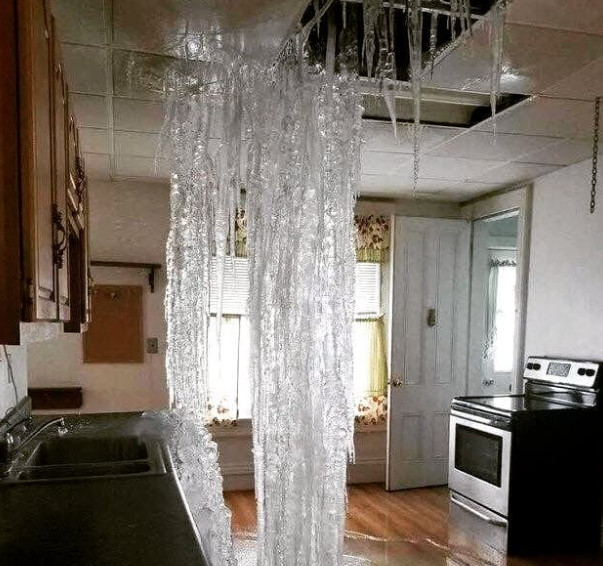
I thought this article would be appropriate for the temperatures this week:
Here are a few tips from the experts to protect a home from the extreme cold:
Open cabinet doors. This may seem unusual, but HouseLogic, a home maintenance and remodeling website operated by the National Association of REALTORS®, suggests opening any cabinet doors covering plumbing in the kitchen and bathroom during cold weather. “This allows the home’s warm air to better circulate, which can help prevent the exposed piping from freezing,” the site notes. “While this won’t help much in pipes hidden in walls, ceilings, or under the home, it can keep water moving and limit the dangerous effects of freezing weather.”
Insulate. Keep drapes and blinds closed except when windows are in direct sunlight. Also, cover window air conditioners and insulate electrical outlets and switches on exterior walls with foam seals, which are available at home centers. Run paddle ceiling fans on low in reverse (clockwise when looking up) to help circulate more warm air, recommends “Today’s Homeowner With Danny Lipford.”
Turn the faucets on inside. Turn the faucets on occasionally to keep water moving through your system and slow down the freezing process. Aim for about five drips per minute, suggests HouseLogic.
Change filters on heaters. A heater needs to be checked annually to help prevent issues later on. But until you can schedule a checkup, change your filters, especially if you haven’t done so in a while. A clogged filter can prevent heat from getting into the home. “It’s no different than our vehicles that require preventative maintenance,” Steve Kistner, general manager at Kalins Indoor Comfort, told KTIV.com. “Our heating and cooling systems need the exact same things so they can work when we all count on them in this extreme cold. Eighty to 90 percent of the calls we go on right now are maintenance-related.”
Check outdoor connections. Make sure any outdoor spigots on all hoses have been disconnected and the spigots have been turned off and drained, advises the Madison Water Utility.
Shut off water immediately if pipes are frozen. If your pipes are already frozen, turn off the water immediately. Close off any external water sources, such as garden hose hookups. “This will prevent more water from filling the system, adding more ice to the pile, and eventually bursting your pipes—the worst-case scenario,” HouseLogic.com notes. “This will also help when the water thaws; the last thing you want after finally fixing your frozen pipes is for water to flood the system—and thus, your home.”
Read more tips on what to do to keep the pipes in your home from bursting at HouseLogic.com.
Reprint of an article from REALTOR® Magazine.
Questions to Ask When Choosing a Lender
I ran across this advice in REALTOR Magazine and thought it was worth passing on. Often times buyers, particularly first time buyers, don’t put enough effort into shopping mortgage lenders to find their best deal. You should contact at least 3 lenders and ask these questions to determine the best deal for you. Once you find the best mortgage product for your needs, obtain a pre-approval letter from your lender. Your REALTOR can incorporate your pre-approval letter with your offer, making your offer appear much stronger to a seller.
Loan terms, rates, and products can vary significantly from one company to the next. When shopping around, these are a few things you should ask about.
General questions:
What are the most popular mortgages you offer? Why are they so popular?
Are your rates, terms, fees, and closing costs negotiable?
Do you offer discounts for inspections, home ownership classes, or automatic payment set-up?
Will I have to buy private mortgage insurance? If so, how much will it cost, and how long will it be required?
What escrow requirements do you have?
What kind of bill-pay options do you offer?
Loan-specific questions:
What would be included in my mortgage payment (homeowners insurance, property taxes, etc.)?
Which type of mortgage plan would you recommend for my situation?
Who will service this loan—your bank or another company?
How long will the rate on this loan be in a lock-in period? Will I be able to obtain a lower rate if the market rate drops during this period?
How long will the loan approval process take?
How long will it take to close the loan?
Are there any charges or penalties for prepaying this loan?
How much will I be paying total over the life of this loan?